Nonfiction from Gail DiMaggio
Helpless
Why didn’t we help, a neighbor asks me, though helping them wasn’t really possible and it’s too late now, anyway. Wolves, she adds. Even wolves help their own. I’m not sure she’s right about the wolves. I decide to look it up later.
—§—
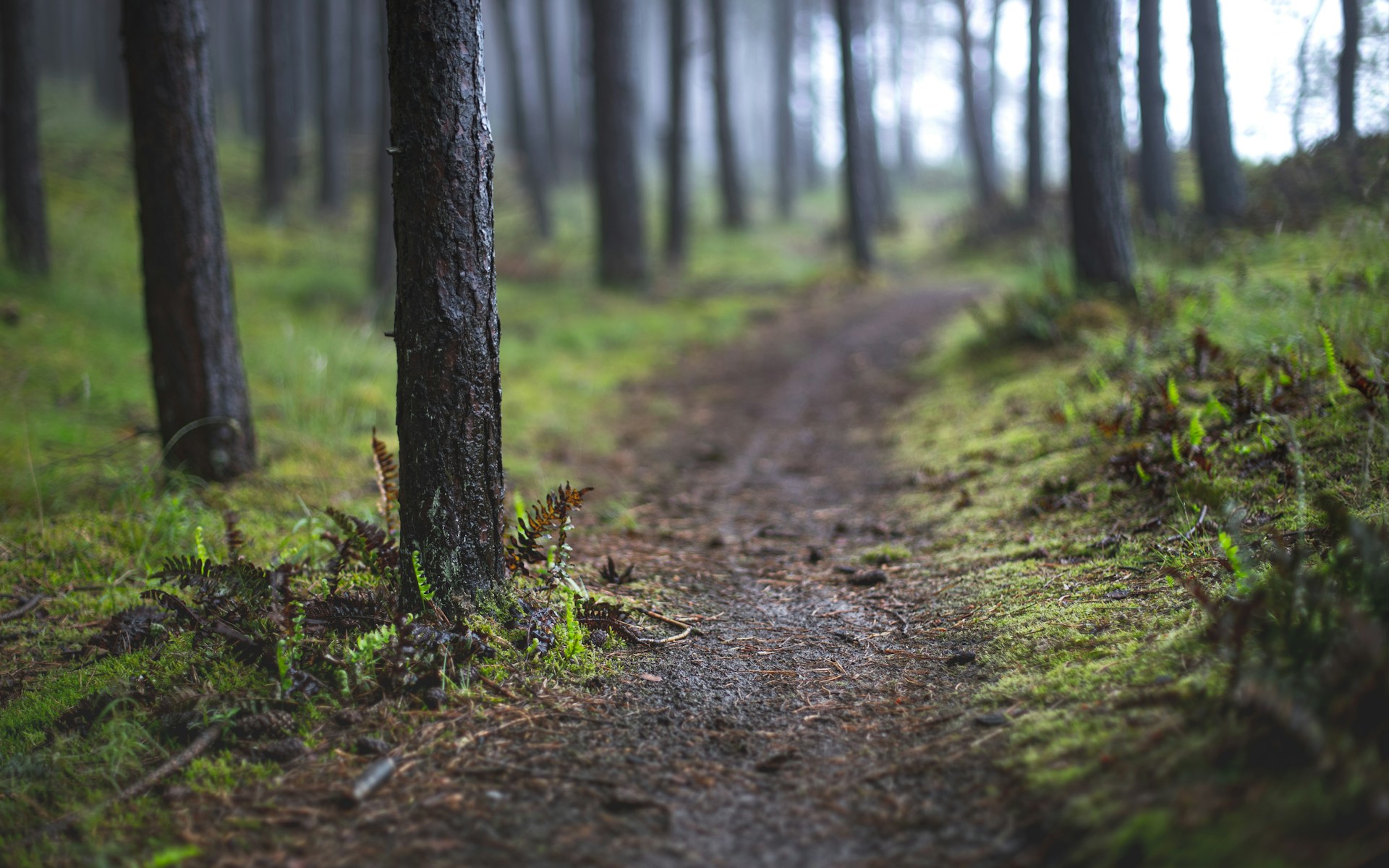
It’s June, 2022. Concord, New Hampshire, our small, neighborly city. A retired couple named Stephen and Djeswende (Wendy) Reid leave their home in our pleasant suburban neighborhood to walk their black lab on the Marsh Loop. That’s a long trail even for this woodsy part of town, so possibly the Reids expect to turn back at the swamp lookout. A mile out, that path, and real forest. Probably they feel safe—held—by the familiar shade of hemlocks and pines. Nothing seems truly wild, let alone dangerous.
The bodies are found the following morning. The police don’t say exactly where. They’d both been shot, more than once. Also, the dog.
—§—
I confess this next story feels like a film jump cut. It takes place in the same comfortable neighborhood off East Side Drive in Concord in August, but all the characters change.
Wednesday morning. I’m walking through my apartment complex with a handful of mail. The day’s full of greening oaks and linen-white clouds, in love with its own ordinary beauty. I’m in a good mood, because I’m a sucker for ordinary, when suddenly a single syllable sails after me. It’s an O sound, not an A sound, so no one’s calling my name.
I barely pause.
Then, the sound again, harsh as a hawk’s cry, still nothing to see beyond a row of mini-lawns like green handkerchiefs. Seconds later, a louder shout, this time angry, and when I turn toward the nearest cottage, the one to my left, I see something.
The blue door is open inward. The screen is swung halfway out. There’s a head that my first survey missed because it’s not at standing height, much lower in fact, only about three feet above the floor.
I’m looking at a woman’s face, the rest of her somehow deleted.
—§—
Months after the Reid murder, neighbors keep bringing it up—dinner parties, picnics, chats on the street. We are a little obsessed. And in the dark, alone, some of us are afraid.
Two of my friends stop using any other trail. One of them begins to call Marsh Loop “the murder trail.” A friend known for her big heart, begins to fear a homeless couple who has been sleeping in the woods behind us for over a year. Another woman installs a smart camera that broadcasts to her smartphone whenever anyone passes her front door.
I read everything I can find about the manhunt for the murderer. I skim the Reids’ obituary.
For those of us who didn’t know them personally, the Reids soon vanish from the tale, minor characters in a novel. Candidates for bad guy proliferate, and I’m often the one collecting the versions, handing them on—Could be a drug addict. Could be a CIA assassin. I’m a kid at a slumber party, soothing myself by scaring the hell out of everyone else.
—§—
There’s an embarrassing gap before I see—not a woman’s head like a float in mid-air—Joan, my paraplegic neighbor. Not the usual Joan with bright blue eyes, beautiful face, downright personality, and a way of swinging the bulk of her motorized wheelchair through every crowd. Another Joan, sprawled on the floor of her hallway, shouting the wrong name.
I’m breathless when I reach her. Still expecting some every-day explanation, I say, Hi. I say, What’s goin’ on? and she answers, But something broke it.
Only then do I pick up on the obvious. Like, where’s the wheelchair? I’ve never seen her without the wheelchair. There’s neither sound nor sign of anyone in the rooms behind her. Everything seems in its place, ordinary and peaceful except for Joan herself.
How did she get out here in the hall? Without the wheelchair, which she operates with her right hand, the only working limb she owns? How has that braced and fragile hand gotten her down a long room to the doorway?
—§—
Joan and I, the Reids—none of us knew each other, though Joan was a familiar sight on my block, and I may have passed the Reids now and then near the lookout. Maybe. But it doesn’t really matter. The puzzle-play of my mind keeps setting the two events down near each other to see if something fits. To find out how one story might explain the other.
I admit I am addicted to the lure of the always-receding-before-me explanation. I need a story that explains. If necessary, I create one. When terrible suffering erupts into my oh-so-orderly world, my magpie mind gets to work weaving bits and pieces into a nest or nightmare because anything must be truer than the inexplicable world.
—§—
According to the obituary, the Reids marry in 1976 and spend their lives working for the Peace Corps, then USAID, applying an apparently tireless gift for hope to the struggles of vulnerable people in a dozen nations. When most foreigners leave Port-au-Prince, Haiti after the 2010 earthquake, they stay to work in the shattered cities with all those displaced persons. Because they have the skills. Because, as usual, they choose to help. Then they return to Concord, NH, where Steve was born, as were their children. Then they decide, one hot June afternoon, to take their dog for a walk in Broken Ground Woods.
—§—
I ask Joan, What is it that’s broken? Are you hurt? She answers, It never happened before.
I grow determined to get the story out of her. Of course there’s a story, and she can tell it to me. I try again. The wheelchair? Is your wheelchair broken?
And she stares up at me. Baffled.
And again, It’s not your arm, is it? Is your arm broken Joan?
And she says, Someone needs to file it, right now. It will go bad if it’s not filed right now.
—§—
I used to read murder mysteries. I loved the ritual of the fictional murder. The chaos of the crime, the long intricate puzzle of the search, and if I just keep reading, I’ll know who. More important, I’ll know why, and when I know why, then, magically, I’m safer.
Terrible things may happen but I’ll be the main character, the one who understands why.
A year later, the Concord police locate and arrest a 26-year-old man named Logan Clegg for the murder of Steve and Wendy Reid. The trial hasn’t begun as of this writing, but the prosecution claims that at some point on that summer afternoon he used a Glock he’d stolen from a sporting goods store to slaughter two people and a dog.
According to a 2022 article in The Boston Globe, Clegg was a wanderer, small-time burglar, shoplifter, purse snatcher. He supported himself with low-level thievery. So maybe the Reids’ death was a small-time robbery gone wrong. In Spokane, in 2017, Clegg killed a man in a parking lot brawl, claimed self-defense, and was never charged though he stabbed the guy ten times.
That sounds like the eruption of uncontainable rage, doesn’t it? So did the Reids somehow provoke that rage? Threaten him? Where did his rage come from? His father’s death by suicide when Clegg was twelve? Is that the source of his suffering and ultimately the Reids’? Is that the point at which help might actually have helped?
Or maybe it was the dog. Maybe Clegg was afraid of dogs.
—§—
I ask again, What did you break Joan? Where does it hurt? By now, I am frustrated. Almost angry. Well, no—irritated. I want her to explain, I want her to tell me what I should do. I want the Joan I expect, not this helpless creature looking up at me, forcing me to look down at her. She hasn’t even gotten my name right. I have no cell phone with me and ask for hers, but she doesn’t seem to understand. I say, I want to call an ambulance. She says, But this isn’t big. This isn’t something big, and for the first time she sounds fearful.
A sluggish half-thought stirs at the bottom of my mind. I foresee a great reversal. A rising up of the big thing. Someday, I will be the one on the floor and someone will tower over me. And my words will scatter, fall away—all of them useless, all of them wrong.
—§—
There is a place in my mind where stories breed against my will. Pictures I’d rather not see live there, and that’s where at unexpected moments I imagine the Reids face to face with a stranger immune to their talent for offering help. A stranger with a gun.
Did the sound of the dog’s shrieking bark fade out? Did the illusion of ordinary day fog over? Or shred, like so much scrim? Did the green drain out of the oaks and the pines, the sky turn black? How long before they foresaw the ending?
I don’t know anything. Except this: one of them had to be second. One of them had to watch the terrible shattering of the other. And this: no one came to help. Believe me, I know it was probably too late to save Wendy and Steve when they put the leash on the dog. God knows, it’s too late now. But it torments me—the randomness, the pointlessness, the injustice—that these two tried all their lives to be of help and no one was there for them.
—§—
Joan’s story gets the fortunate ending. I run to the main office where someone phones. Nurses arrive, then an ambulance to take Joan to whatever help she needs: MRI, skillful surgeon, maybe a miracle drug, I don’t know. We aren’t friends, just neighbors, and while she’s grateful, she hasn’t shared details with me. But that’s all right. She’s back among us now, driving that sturdy wheelchair into our gatherings, still downright—and, for the time being—unswervable.
Sometimes I wake up disturbed by images: Joan helpless at my feet. Joan saying, This isn’t big. A nameless figure almost erased by darkness and shadow who might be Joan struck down, or Wendy Reid, helpless under fire.
Or me. It might be me.
I’ve been talking about the Reids and Joan as if the stories have something in common. But the bottom line seems to be that no one could help the Reids, while Joan got the help she needed. The throughline here isn’t in the stories, it’s in my need to believe that if I understood the facts, the motives, the why and then the why of that why—then I’d be safe.
A friend once described the trails in Broken Ground Woods as a bullseye, meaning the longest trail wraps around others and the shortest lies nested in the outer four. I walked those paths for years, picturing myself on one of the rings. Inner ring or outer, didn’t matter; I thought I knew where I was.
One day I Googled a trail map and learned that only the circle part was true. These woods do harbor five trails, each returning to its own starting point. But no bullseye makes the pattern coherent. No center holds the wandering together.
More and more, I distrust my longing to situate myself on some clear and shapely trail map. It’s a distraction. Anyway, it can’t be done. I have another plan now. A modest one, unlikely to save lives.
I’m going to hold myself ready like the Reids in Haiti in 2010. And when I see a chance to help, I’ll help. Of course, the world will go right on feeling like a child’s scribble on a blank page, and I will go right on being afraid.
.
.
Gail DiMaggio’s first book, Woman Prime, was selected by Jericho Brown for the 2018 Permafrost Poetry Prize and published by Alaska University Press. Her work has appeared recently in The Ekphrastic Review, The Whiskey Island, and Raw Arts Review, where her poem “We Look into Fire” was a runner up for the Mirabai Prize. In 2022 five of her poems received that year’s Passager Poetry Prize. She resides in Concord, NH and has recently begun to concentrate on prose forms.
 atlasandalice.com
Leave a comment