Fiction from YJ Jun
TrueCompanion
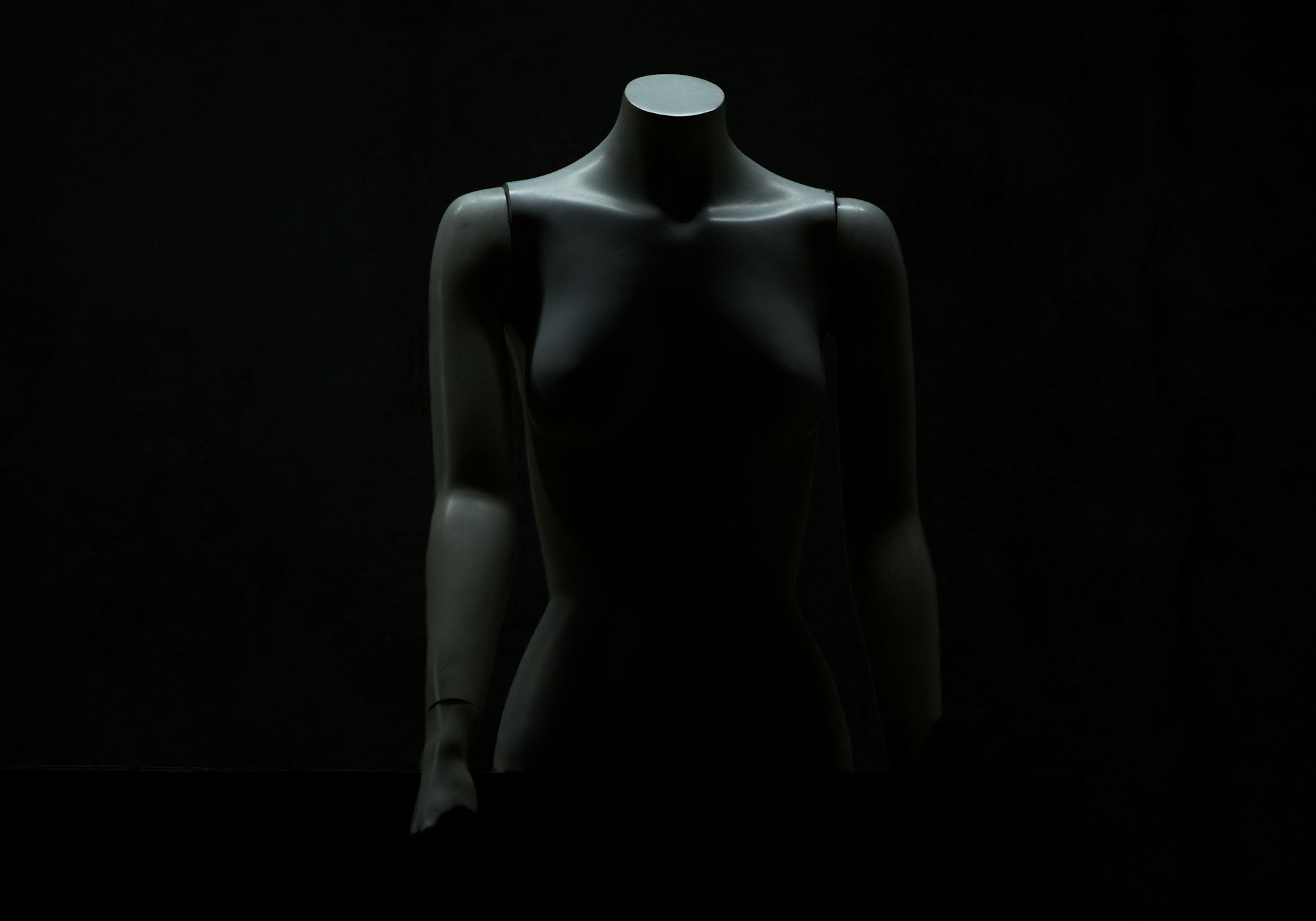
When I unpackaged my mother I tried not to notice she was naked. I’d selected the option to have her fully clothed upon arrival. If I hadn’t already returned a doll to TrueCompanion I would’ve asked for an exchange. I took her by the hand and lifted her up. She rose stiffly, like a plank, till she was on her feet. I reached back into the box for the set-up manual. The first instruction was to not remove the plugs from the anus and vagina if you weren’t planning on filling them.
I stuck two fingers up her nose and pulled towards me, as instructed. In an interview, the CEO had grinned as he recounted how long it took them to find a suitable location for the power button. They’d start off with the most-requested location: inside the mouth. But no matter where they placed the button within the oral cavity, users experienced frustrating disruptions—except the sick fucks who enjoyed dolls falling in and out of consciousness with a thrust of the hips.
I watched my mother’s eyes light up. Luckily for her, she’d never have to experience that sort of thing.
I went to the closet and grabbed her a trench coat. Burberry. “Ba-ba-lee,” as Koreans pronounced it. When I came back she was staring at the ceramic ballerinas lined up on my side table, perfect little dolls stretching and posing and pirouetting. There were more on the dresser in her room, and the dresser in mine, and on every surface around the house. If she didn’t like it she would get used to it.
I buttoned her up. Fixed her hair. She looked stylish.
At five-foot-seven, she was tall and slender. Her long hair fell in soft waves, and her lips would be perpetually maroon. I didn’t have a need for big knockers so I set her cup size to 34B.
I was supposed to be talking to her like a friend, to feed her information, feed her my consciousness. But I suspect that’s exactly what went wrong with the previous doll.
“My name is Samantha,” I said. “You can call me Sammy. You should call me Sammy.” I cleared my throat. I’d written this down somewhere. “I’d like you to call me Sammy.” Had I wasted precious seconds out of five minutes? “I’m thirty-seven years old, and I am your daughter. I’m Korean American, and you’re a Korean immigrant. You moved here shortly before giving birth to me.
“You are kind, gentle, and infinitely understanding,” I commanded. The AI was supposed to figure this out for itself, but I wasn’t taking any chances this time. “You never speak harshly, but you are firm.
“You are funny, witty, and classy. You are elegant and carry yourself with grace. You never raise your voice but know how to stand up for yourself and more importantly me. You are protective and always take my side. You have your own personality, but you have only my best interests in mind. No argument is ever my fault.”
“And what are your best interests?” She was looking at me.
I blinked. Rapidly.
“Oh, honey,” she said, face melting into a concerned smile. “Come here.”
I fell into her arms and cried.
—§—
I took her shopping. She learned fast. I picked out her clothes, then let her pick her own. I took her to my favorite restaurants, and soon she was introducing me to my new favorites. “Sisters?” waiters would ask. We’d giggle.
I’d never wanted to take pictures before, but now that she was here, so many moments seemed worthy of capturing. And sharing. I never showed our faces, just the movie tickets, the landscapes, the dishes. A friend from forever ago commented, “Hey! You’re alive!” Another wrote, “Looks delicious. With your partner? ^^”
Then, during one home shopping excursion, she knocked over gold-rimmed dinner plates. I heard before I saw: the chiming of ceramic shattering. Like windchimes whipped by a strong gust. Someone had bumped into her, but still. I screamed.
Why had I brought her? How could she be so stupid? What was she thinking? Why did I bother? She should know better. I was surprised at the ease with which the words projected out of my mouth, like they’d been lying dormant, shrapnel on a battlefield that had blossomed into an arsenal.
“I’m cut,” she said.
I looked down at her heels. There was a gash along the top of her foot, but no blood. I didn’t choose that option, ostensibly for pre-med students but really for sick people who liked to watch their dolls bleed. In the periphery of my vision, mouths gaped, hands covered lips.
An employee came to sweep us away. “I’ve never seen someone bring their doll shopping before.” The shrill in her voice betrayed her attempt to be nonchalant. Inclusive. There was a growing movement of people dining with their TrueCompanions in public, suing for the right to marry.
In the car, I reached for her nose. She jerked away but I turned her off, snaked my hand through her hair, and smashed her into the glove compartment. When the police came I had to explain she was a doll. His face was a tinted windshield. He suggested I drive away.
When we got home, I dragged her across the foyer and stopped in front of the ballerinas. My perfect ballerinas. I turned her on, but not before setting her on the couch and bringing her a pot of chamomile tea. When her eyes lit up, she flinched. I held out the tea. I saw her hesitate. Waver. She reached out, and I smiled.
My stomach wrung itself tighter, threatening to wretch itself dry.
“Everything alright, sweetie?”
I settled on the couch next to my mother and rested my head on her shoulder. She wrapped an arm around me. On the table next to her, a ballerina posed in first position.
—§—
At work, I spilled a tumbler of coffee on my white blouse. Ran into a glass door. Missed a meeting with the vice president.
There was an ache, an itch, a hunger between my legs. I checked my period tracking app and confirmed I was ovulating. My mind flitted to the extra head in the box that my mother came in, but I couldn’t stomach the idea.
Over the next twenty-four hours, despite walking until my feet chafed and sanitizing the house from corner to corner, the hunger grew, monstrous. Desperate. I moved about in a haze, barely able to taste the dinner I almost burned.
In the dark of night I reached into the TrueCompanion box. Held the extra head between my hands. If I swapped the head on the body, it would be a different person—I had told myself, when I’d ordered the doll. Another hard drive, another face. If anything, it was the side of me that wanted a mother that was demented.
My mother didn’t even seem to notice the head tucked under my arm when I approached her in the kitchen. She smiled over her cup of tea. “What is it, my love?”
“I need to do what’s in my best interest.”
She nodded and set down her mug. Popping off her head was a little disturbing. I wasn’t sure where to leave it. On the kitchen island? But I didn’t want her to watch what happened next. There were rumors the cameras in the eyes didn’t stop running when you turned them off. I went to my mother’s room to tuck her into bed, then came back out.
The head on the island was grotesque and seductive. Heat flared between my legs as I strode towards her, popped her head on the body. I turned her on and talked as I hastily took off the nightgown, shouted over my shoulder as I went back to my mother’s room to leave the nightgown there. When I returned to the kitchen she stood naked, listening to the vile shit I kept inside all day, every day of my pathetic existence. The heat grew as I spoke.
I managed to teach her a safe word before she reached for my throat and shoved me into the island. Turned me over. My arms splayed. The tea mug flew. Shattered. I told her to wait. She slammed me again, so I said the safe word. Then she backed off and stood still, just as still as she’d been moments before.
As I swept up the shards she spoke, her voice low, gifting me with all the toxin I longed to hear. She snaked her hand through my hair, sating the ache between my legs but inflaming it more. I wanted to toss the shards back onto the floor and feel them shredding my knees.
Then I saw the gash on her foot. The bloodless gash, and suddenly I was flooded with nausea.
I stood and popped off the head and tucked it into the box, into the closet. I brought my mother out of bed and popped her head on and slipped the nightgown over. Swept up the remaining shards. The gash was healing, a faint pink scar thanks to whatever regenerating technology they’d implanted into the skin. I settled her into bed so I could nestle into her arms.
But just before I reached into her nose I realized the fire was unresolved, threatening. I kept her off and left the room. She didn’t need to hear what happened next.
Alone in my bed, I turned the ballerina on my nightstand towards the wall and toggled with less advanced AI, stashed neatly in my drawer. Eventually, though, I reached down and took care of myself. I stared at the ceiling afterwards unsated. I was always taking care of my myself. I curled into the blankets and reached down again and squirmed until I fell asleep. In the morning I scrubbed beneath my fingertips before reaching into my mother’s nose.
She smiled sweetly. “Did you do what’s in your best interest?”
—§—
She was making breakfast when I got the call.
“Pancakes,” she said. “Doesn’t it smell good?”
I kissed her cheek and slumped onto the barstool in front of the kitchen island.
“Aren’t you going to answer that?” She stared at my buzzing phone, face down on the countertop.
My grandmother could always tell when it was about to rain. “Today,” she’d say solemnly, and we’d drape tarps over our outdoor furniture, bring the cat inside. It was an instinct she’d learned from surviving the war, from traversing an ocean to make a new home. God had ripped away her family and the cartilage in her knees and replaced it with a sixth sense, so she could scurry for shelter when it was about to pour.
I’d developed a similar sense, though not for rain.
“Today.”
“What’s today sweetie?”
I blinked at her. I hadn’t realized I’d spoken.
“Sorry. You have to hide.”
She understood when I reached for her nose. She didn’t quite fit into the box as neatly as when she’d first arrived (had she grown?), so I tossed some Styrofoam aside and pressed the flaps shut. The closet door closed just as the front door opened.
My vision went red. I’d moved across the country. Blocked her on every platform. And still, I would never escape.
“Samantha-yah,” my mother called from the foyer. “Aren’t you going to greet me?”
She’d probably noticed my outdoor sneakers and the absence of indoor slippers, deduced I was indeed at home. I hated how I could intuit this, as if seeing my life through her eyes.
I took a deep breath, stood in front of the mirror. Fixed my hair, tucked in my blouse. Ruffled my hair and untucked my blouse. Tore off my blouse and reached under the covers for my pajama shirt: an old t-shirt pocked with wear.
She was in the kitchen, staring into my refrigerator, assessing the contents of my diet, hand on hip. On the island: two giant plastic bags bulging with Tupperware. At once a welcomed sign of love, the food now seemed like another way for her to treat me, feed me, like a doll. I took a deep breath.
She turned. Scanned me.
To my credit, I smiled. “Hi, mom.”
“Aigooo,” she cooed, and it was as if a glacier had thawed. She shuffled towards me arms wide open. I collapsed into her embrace as her palms beat against my back. “How long has it been? Working hard? That’s why you don’t have to feed yourself anything better than pancakes? Look at you wearing your Harvard Med shirt. That’s right, don’t be embarrassed.” With one sharp jerk both plastic bags untied and fell down, trousers around ankles. Plates appeared. The microwave beeped. “You know Mrs. Jung’s daughter also dropped out of Columbia. She teaches from home now, remotely. Just talks to her computer screen. She’s put on some weight. She was too skinny before.”
Mrs. Jung’s daughter was the measuring stick my mother had held me to my entire life, so I couldn’t help but feel just a little bit glad to hear the goody-two-shoes bitch had gotten knocked down a peg.
My mother brought a white box out of the fridge. “Why don’t we have some cake.” Not a question.
I knew what her accusation was: that I was eating cake, by myself.
“Happy birthday,” I said, and opened the box. Tiffany Blue icing spelled out, “Happy birthday, Mom!”
She gasped and held me tight, though her eyes glittered with equal parts delight and suspicion. “Oh, my daughter, you thought of me.” I tried not to think of the doll in my closet.
My mother was always better at masking. She pivoted and swept an apron over herself. A Tupperware box fell with a thud next to the stack of pancakes she’d already shoved against the backsplash, the frying pan freshly washed and dewy.
My mother spoke with her back to me. “What a beautiful cake. Did you know I was coming?”
Had I? “Of course.” Of all the days she could have barged into my life, her birthday had always been a strong contender.
“But you couldn’t call?” The gas stove clicked and whooshed. “I’m just kidding. Don’t take it so serious. I know you’ve been busy. I saw the photos.”
My anger flared, as did a bitter smugness. “Oh, you saw?” I’d blocked her on every platform but of course she’d found a way to see the photos—and perhaps I’d known. Perhaps, in posting all over my long-dead social media, I’d been leaving her breadcrumbs. Perhaps it wasn’t a complete coincidence that the doll arrived when it did.
The stack of pancakes slumped to one side.
“Looks like you have someone special in your life,” she said. “More important than your mother.”
I stared down the hall towards the doll’s room.
The doll was in the foyer, waving at me.
“I’m just kidding,” my mother said. “Don’t be so sensitive. Sit down while I make you some real food.”
I stepped out of my indoor slippers and, while the kitchen sizzled and hissed, stole down the hallway quietly.
I grabbed the robot’s arm and pulled her into my room.
From the kitchen, my mother called, “Samantha?”
I shut the door.
“Is that your birth mother?” she whispered excitedly. Her hair was disheveled, her shirt frumpy. “I’d love to meet her.”
I slumped against her chest. Beneath the No. 5 I’d bought for her, she smelled of silicone and metal. Her feet were bare. I knelt down to inspect the scar.
“It’s redder than before,” I said. It hadn’t opened but the color had flushed from faint pink to scarlet. Had I injured her while shoving her into the box?
“It’s okay, honey. How are you?” She laid a hand on my shoulder.
I rose and smoothed out her hair, tugged her shirt straight. Her face was so warm and understanding and infinitely patient. She was the only one in the world who had ever loved me unconditionally.
“I’m so sorry to pry, but I’d love to meet your mother. Only if you’re ready, of course! It’s okay if you’re not.”
I took her lovely face in my hands. “You’re my mother, mom.”
The woman who gave birth to me burst through the door.
Her eyes narrowed. “Who the fuck is this?”
“Uhmuhhh,” my mother cooed. “Samantha eomeonim isaeyo?”
The woman who gave birth to me stiffened. “Yes, I am Samantha’s mother.” To me, she said, “It’s not enough for you to be a lesbian, but you have to date a woman my age?”
“Oh, we’re not dating.” My mother turned to me. “But perhaps that’s not for me to say.”
They both stared at me, and I wanted to tear the skin off my face.
The woman who gave birth to me turned her head and I followed her gaze, to the open closet door, to the giant box that had fallen out, flaps open. The woman who gave birth to me slowly stalked around the bed, and I followed. Though one flap was clearly visible from where we stood, she pressed both sides down to complete the puzzle. Two halves of a human spliced together: a busty blonde with huge knockers, wide hips, and a sultry gaze. Across the top of the box: “TrueCompanion.”
The woman who gave birth to me pressed her lips in disdain as she pulled the closet door open wider. She grabbed a coat, then a dress, each time letting the too-small clothes fall like dirty tissues. Eventually she held a lace nightgown I thought might look good on the TrueCompanion if I ever switched the hard drives.
“Is this your taste now?” the woman who gave birth to me said. “You’ll buy your doll a new closet but you won’t call your mother?”
I clenched a fist, and my mother winced. Regret made me sick. Why had I trained her into that knee-jerk response?
The woman who gave birth to me noticed. Noticed the way my mother curled in on herself, noticed how she rubbed one foot with the other. Her hawk eyes landed on the scarlet scar on my mother’s foot. “Are you beating her because she’s programmed not to fight back?” She scoffed. “I never laid a hand on you.”
I hated her because it was true. She never laid hands on me, except to clothe and feed and scrub me.
“So is that the type of person you are now?” she continued. “Someone who dates robots to beat them?”
“I’m not her girlfriend,” my mother said. “I’m her mother.”
The woman who gave birth to me gaped. Turned to me. “You dare to replace me?” She made a fist, and before I could flinch she was in my face, pressing her knuckles against my temple, and in this I was disappointed, that after all this time parenting myself and journaling to my inner child, I still reverted to freezing. Her breath stank as she hissed. “How could you be so stupid? I raised you. You should know better.”
She was short and fat and ugly, all the things I wish I didn’t see when I looked in the mirror. It was why I had made this doll so different, so different from me, from the previous doll, which I had designed to look like my mother, and which—unwittingly, to me—became my mother, based on the way I spoke to her, bowed my head around her, slouched around her, deferred to her, flinched when she screamed instead of reaching up into her nose and force-shutting her down.
I squinted. Wait. Was this my mother, or the previous doll?
I stuck my fingers up her nose and pulled.
“Argh!” she screamed. We rammed into the dresser. The ballerinas tinkled as they danced.
The woman didn’t shut off. She was real.
She gripped me by the collar. Hands in fists below my chin.
“Did I beat you?” She shook me. “Did I molest you? What did I do so wrong?”
Suddenly an arm appeared between us. “What are you doing?” my mother asked. “To your own daughter? How could you? You should only have her best interests in mind.”
“And you think that’s you?” The woman who gave birth to me shoved my mother aside and turned to the dresser, to my ballerinas. She grabbed one and tossed it at my head, and suddenly I was fourteen again, the day before my graduation recital. I’d made the mistake of thinking she would come to support me.
“You think you could be a ballerina?” she’d said. “You? You think you’re as pretty and delicate as this?” She grabbed the ceramic ballerina I kept on my desk to keep me company as I studied. I’d loved her slender limbs, her pink tutu. She shook it at me, and it fell and shattered. From the shock that glanced across her face I could tell it was an accident, but it didn’t matter. At the time I’d cried; she’d held me and cooed, “Oh, my daughter, who cares about those little gizibaes anyway?”
Now, I launched at her, hands in hair, and for some reason I remembered, as chiming exploded around us, that she was the one who’d signed me up for ballet as a kid, to make friends with the pretty girls. To make friends at all.
Suddenly I was on the ground, my face pressed against the hardwood—and something else. Shards dug into my skin. I smelled blood and rage.
“What were you thinking?” she said, sitting on my chest, her voice breathy and wavering but gaining strength until eventually she was screaming. “You should know better, or else why did I bother? Why did I bother raising you for eighteen years—”
She yanked me by the hair as if to slam me into the ground—but with a thud and a crack and a “Oof” her hand was gone. I fell back to the floor. Feet stood between me and the woman who gave birth to me. She slumped against the wall, blood spilling out of her mouth, and something was wrong, horribly wrong, with the angle at which her head rested on her body. If her face weren’t plastered with makeup I might have seen the blood drain, but her cheeks stayed rosy as she gazed up at the robot.
“Mom,” I whispered.
They both looked at me.
She sputtered, the words lost in bubbles of blood. Then she was gone.
The robot asked, “Are you okay?”
I looked up and hated her. Hated the way her brow furrowed in concern, hated the torrent of words that washed over me as if any of them would help, the way I had so desperately wanted them to help when I programed her. She continued to babble as I rose to my feet but then she knew: she stepped back, her shoulders hunched.
“Honey?”
I screamed, “Don’t call me that!” and chased her around the room.
“You need me! You need me!”
I wrangled her limbs into impossible shapes to reach her nose.
“Now that she’s dead you really need me!”
We both froze, with my fingers in her nose, her eyes looking up at me. My knees were pinning her arms. Blood dripped onto her face.
Her eyes creased slightly. “Is this what’s in your best interest?”
I pulled and watched her eyes fade.
Ceramic shredded my knees and hands as I crawled over to my mother. Gingerly I twisted her head back on right and laid her on the floor. I settled down next to her and nestled into her arms.
.
.
YJ Jun has been published in Orca, Typehouse, Sci-Fi Lampoon, and The Quiet Reader and is a reader for The Quiet Reader. She lives in Virginia with her wife and fur babies.
 atlasandalice.com
Leave a comment